
Why High-Performance Food Grade Lubricants and Greases are Critical for Plant Safety and Reliability
Ideally, only food-grade lubricants and greases should touch nearly every piece of moving equipment in processing plants. The consequences of choosing the wrong product extend well beyond additional maintenance. Misapplied lubricants can create contamination risks, compliance exposure, and accelerated equipment wear.
Selecting the right lubrication products across zones often requires finding a partner with the range and the expertise. Bunzl Processor Division is a leading single-source distributor for food and meat processing facilities, offering professional-grade supplies and equipment that help keep plant operations running safely. As part of that expertise, we carry a full line of CRC Industries greases and lubricants, covering both food-grade and non-food-grade formulations.
Why Classification of Food Grade Lubricants and Greases Matters
Not every lubricant is safe for every part of a food processing plant. The National Sanitation Foundation (NSF) defines two primary categories. H1 lubricants are approved for incidental food contact zones, where product exposure is possible. H2 lubricants are restricted to areas with no food contact risk, such as certain utility systems and facility maintenance equipment.
Using an H2 product in an H1 zone isn't just a paperwork issue. It's a contamination risk with real consequences. Failed audits, corrective action, and potential product holds follow when lubricant records don't hold up to scrutiny.
We are proud to share that CRC Industries' food-grade lubricants meet NSF H1 standards. They perform under the conditions common in food plants: high moisture, temperature swings, frequent washdowns, and continuous mechanical stress. Choosing H1-certified products for incidental-contact zones removes a significant category of risk.
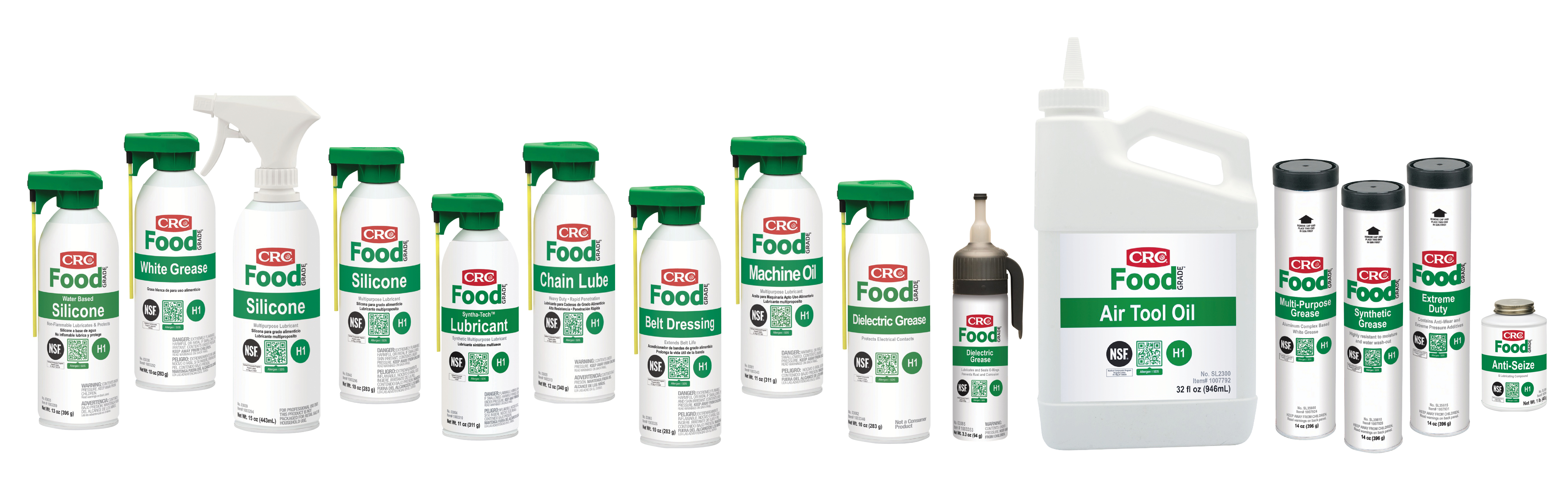
CRC Industries’ food-grade greases and lubricants meet NSF H1 standards.
The Food Safety Modernization Act (FSMA) treats lubricant traceability as part of the food safety record. Plants that log what was applied, where, and when are far better positioned during inspections than those working from informal practices. It's a simple discipline that pays off when auditors arrive.
The Performance Case for High-Performance Food Grade Lubricants and Greases
Compliance is the floor, not the ceiling. The stronger argument for quality lubricants is what they do for equipment reliability and total maintenance cost.
General-purpose greases break down faster under the heat, pressure, and chemical exposure common in meat and food processing. When a lubricant fails early, bearings wear faster, equipment runs rough, and maintenance intervals shorten. That failure doesn't announce itself clearly. It shows up as accumulated labor hours, increased parts spend, and line stoppages.
The cost adds up in ways that aren't always visible. A re-lubrication that happens twice as often as needed takes twice the labor. A bearing that fails six months early costs more than the grease that could have protected it. Plants that use quality formulations spend less time reacting to problems and more time running product.
CRC Industries offers specialty formulations built for these conditions. Syntha-Tech™ with PTFE delivers strong load-bearing performance and lasting protection in high-friction applications. For seized or corroded components, Knock'er Loose® penetrants free stuck hardware without damaging nearby equipment. These aren't general-purpose products adapted for food plants. They're engineered for the demands processors face.
The practical payoff is measurable. Longer re-lubrication intervals reduce labor time. Better wear protection extends equipment life. Consistent lubrication quality means fewer unplanned stops. Across a plant running five or six days a week, those gains compound quickly.
Managing Both H1 and H2 Products Across Zones
Most food processing facilities use both food-grade and non-food-grade lubricants. H1 products belong in processing and packaging areas. H2 products fit utility systems and equipment kept well away from food zones. Managing both without mix-ups is where well-intentioned programs can break down.
Maintenance teams work fast and across multiple zones. Equipment gets serviced by different technicians on different shifts. Without clear visual cues between product types, the risk of a wrong application grows with every shift change.
CRC Industries addresses this with its Greenlight® and StopLight® visual ID system. It makes clear which products belong in food-contact areas and which don't. That built-in clarity helps catch errors early, and it matters most in high-throughput plants where there's little room for correction.
Beyond the plant floor, CRC's non-food-grade formulations also serve automotive and industrial maintenance applications. Plants managing fleet or transport equipment can source those products through the same Bunzl account, which keeps procurement simple.
Reducing Foreign Object Risk Through Product Design
Foreign object contamination is a persistent concern in food production. Aerosol lubricant spray straws are a documented source of risk. In a busy maintenance environment, a straw set down near a production line can end up somewhere it shouldn't.
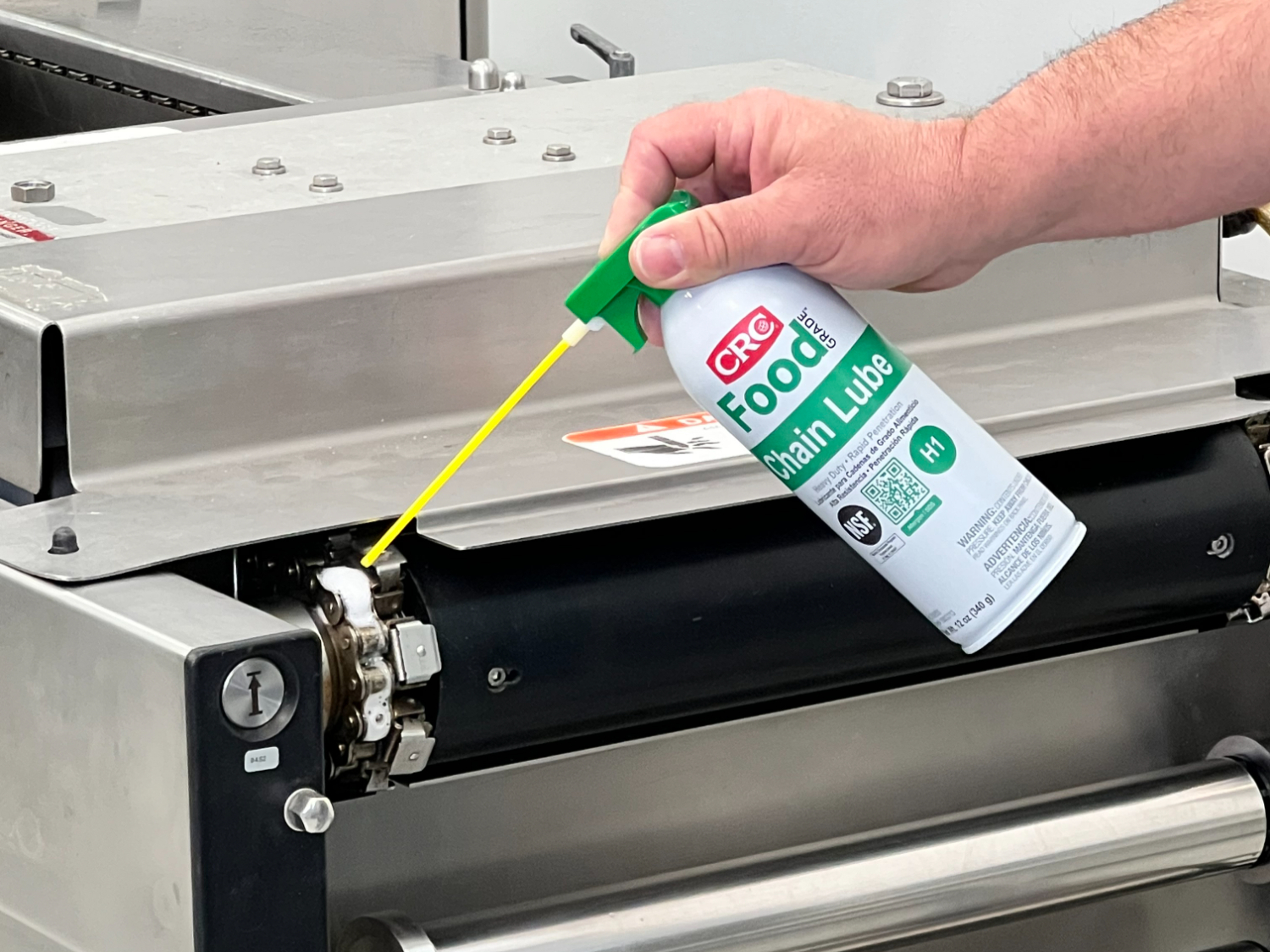
CRC’s Food Grade Chain Lube contains a blend of synthetic lubricants and mineral oil to keep roller drive and conveyor chains well lubricated. This lubrication protects moving parts by reducing friction and wear.
CRC addresses this with the Perma-Lock® integrated actuator, which keeps the spray straw permanently secured to the can. It can't be removed, set aside, or dropped near a line. When the straw stays with the product, it stays out of the product stream.
In a HACCP program, every contamination pathway needs a documented control. Products that address risk through design reduce the number of controls teams track manually. Fewer loose components on the floor means fewer corrective action entries and a cleaner audit record.
Building a Full Lubrication Program with Bunzl Processor Division
A reliable lubrication program needs the right products matched to the right zones, with clear records that hold up in audits. We at Bunzl are proud to carry the complete CRC Industries line of greases and lubricants. This covers a whole range of food-grade greases, penetrants, anti-seize lubricants, and specialty formulations for high-demand applications.
Additionally, anti-seize products deserve specific attention. Threaded fasteners across a plant face constant moisture, temperature change, and cleaning chemical exposure. The right anti-seize product prevents galling and corrosion. When an H1-rated option is selected, it stays compatible with food zone requirements as well. CRC offers both food-grade and non-food-grade anti-seize options, so maintenance teams have the right choice for every location.
Whether your facility processes beef, pork, poultry, seafood, baked goods, vegetables, or prepared foods, the lubrication demands across your operation are real and consistent. Sourcing from a single supplier who knows processing conditions cuts procurement complexity and keeps your program easy to document and defend.
To learn more about the BPD and CRC Industries partnership, read the announcement on our blog. You can also browse the full CRC Industries’ full range of greases and lubricants, covering food-grade and non-food-grade options for every plant application.
To discuss your facility's lubrication needs with a product expert, contact us directly. Our team can help identify the right products for your equipment, your zones, and your compliance program.