Sweeping equipment carries real contamination risk when the wrong product ends up on a processing floor. Selecting the right heavy-duty brooms and dustpans affects food safety, sanitation efficiency, and audit readiness. Getting it right starts with understanding what your floors and cleaning program require.
Food and meat processing floors handle heavy debris, pooled liquids, chemical washdowns, and constant foot traffic. Standard commercial equipment breaks down fast under those conditions. Heavy-duty brooms and dustpans built for processing environments keep your sanitation program running without introducing new hazards.
Why Heavy-Duty Brooms Belong in Your Food Safety Program
Sweeping equipment is a direct-contact surface in a processing facility, which means it belongs in your hazard analysis. Heavy-duty brooms that shed bristles or a dustpan with cracks that trap organic matter create the kinds of foreign objects and biological risks that HACCP programs exist to prevent. Cleaning tools carry the same scrutiny as knives, aprons, and conveyor components under HACCP principles.
The FDA's Current Good Manufacturing Practice regulations under 21 CFR Part 117 require sanitary conditions throughout the plant, including floors, drains, and all areas adjacent to production. Equipment that degrades under washdown chemicals or cannot be properly cleaned works against that standard. Choosing the right heavy-duty broom and dustpan from the start makes your sanitation program easier to document and verify during audits.
Color-coding for brooms supports both HACCP documentation and daily zone control. Most facilities assign broom and dustpan colors to specific zones, keeping raw area tools out of ready-to-eat spaces. That system only works when the equipment holds its color and structural integrity through repeated use and chemical exposure.
What to Look for in Bristle Material and Construction
When it comes to heavy-duty brooms, bristle stiffness should match your debris type and floor surface. Stiff polypropylene bristles move bone fragments, fat, and solid waste efficiently on production floors. Softer bristles suit fine particles on smooth surfaces but wear down faster under industrial conditions.
Flagged bristle tips, where each filament splits into finer strands at the end, increase surface contact and improve fine particle pickup. In environments where dry sweeping precedes washdown, flagged bristles collect more material per pass and reduce drain load.
Fiberglass handles resist moisture, resist splintering, and hold up under processing plant chemicals. Wood handles absorb moisture, harbor bacteria, and risk introducing physical contaminants if they crack. The connection point between the handle and the broom head also needs to be corrosion-resistant and tight enough to clean properly.
Bristle shedding is a disqualifier for any food-processing environment. The connection point between the handle and the broom head also needs to be corrosion-resistant and tight enough to clean properly. A loose bristle in the product stream constitutes a foreign-object contamination event with recall implications. Verify that the bristle block construction is rated for daily industrial use before committing to any heavy-duty broom for your facility.
Matching Heavy-Duty Brooms and Dustpans to Your Floor Type
Surface texture, slope, and drain configuration should all factor into your equipment selection, especially for heavy-duty brooms. Smooth sealed concrete works well with flat-edged brooms that make full contact across the sweep. Rough or textured surfaces need bristles with enough flex to reach low points without the head skipping or bouncing.
Drain placement and floor slope also determine which broom head width works best. Sloped floors with central drains benefit from wider heads that push debris efficiently toward collection points. Tighter drain configurations need a narrower head for better directional control.
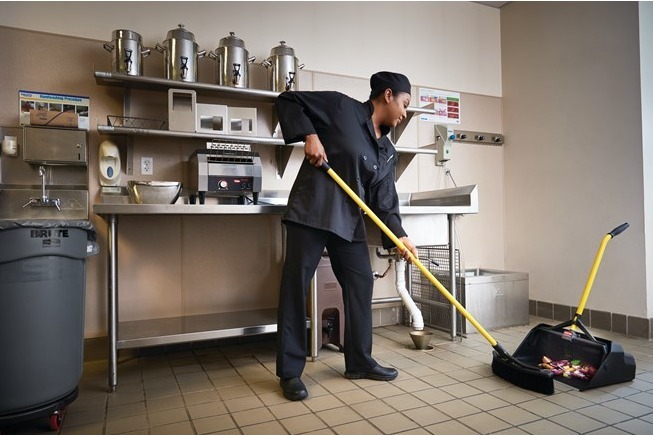
Wet environment dustpans need a tight rubber lip that seals against the floor to collect liquid and semi-solid waste cleanly. The body needs to be deep enough to hold collected material without spillover during transport to the waste collection point. A dustpan that does not seal or hold capacity adds time to every sanitation cycle.
Get the Right Industrial Cleaning Setup for Your Facility
Matching heavy-duty brooms and dustpans to your floor conditions, debris type, and sanitation schedule reduces audit risk and keeps your HACCP program defensible. Facilities that treat sweeping equipment as an afterthought tend to see it show up repeatedly in audit findings and foreign object reviews. The right equipment selection is a straightforward way to close that gap.
Bunzl Processor Division carries a full range of industrial brooms, dustpans, and cleaning tools for processing environments. Need help finding the right setup for your facility? Call 800-456-5624 or chat with us online. You can also reach our safety experts directly by submitting our Ask An Expert' online web form.