Sanitation workers handle shovels across full shifts under time pressure. They load and move bulk ingredients, often while standing on wet surfaces and reaching across conveyors. Handle shape, shaft length, and blade size each affect how the body loads per repetition. When those specs are wrong, the cost shows up in injury rates, not line reports.
The food shovel is one of the most used tools in the food processing industry. Surprisingly, ergonomics can often be a non-priority feature for company purchasers when shopping for this tool. This is a gap with a measurable cost. Musculoskeletal disorders (MSDs) are consistently among the leading causes of lost worktime in food processing.
Meanwhile, the Occupational Safety and Health Administration’s (OSHA) Ergonomics Program Management Guidelines for Meatpacking Plants identified three primary drivers for MSD. These are repetitive motion, forceful exertion, and awkward posture. A food shovel that forces overgrip, overreach, or poor working angle amplifies each of those risk factors. This amplification compounds across every repetition of every shift.
Ergonomics Is a Procurement Decision, Not Just a Safety Program
Most manufacturers have an ergonomics program, but few apply it at the point of purchase. A shovel chosen for price or stock availability rather than for task fit places the burden on the worker's body. Over time, this decision appears in workers' compensation claims, productivity losses, and turnover costs. Often, these costs dwarf any savings made on the equipment order.
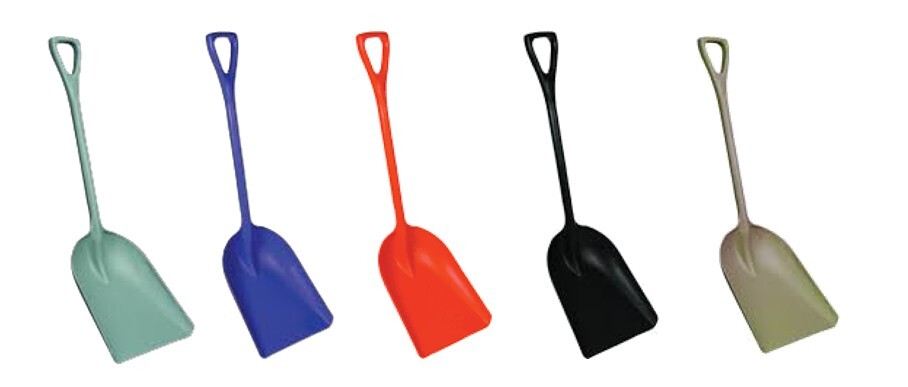
An ergonomically selected food shovel addresses three things: handle geometry, shaft length, and blade design. Each affects how the body loads during use.
Handle geometry determines grip comfort and wrist flexion during scooping and lifting. A handle that is too narrow creates overgrip. A handle that is too thick reduces control. Contoured or D-grip handles help maintain a neutral wrist position. This reduces cumulative strain across a full shift.
Shaft length affects how much a worker must bend at the waist. Workers using shovels that are too short compensate by stooping. This increases lumbar loading over time. A shaft matched to standing height supports a more upright posture and reduces lower back stress.
Blade design affects the force required to move material. A blade that is too wide loads more than the worker can comfortably lift. This leads to forceful exertion on each scoop. A blade sized for the specific material keeps each lift within a manageable range. This applies whether the load is a loose ingredient, waste, or bulk product.
Color-Coding the Food Shovel Compounds the Value
Food-grade shovels in processing environments need to meet more than ergonomic standards. Color-coded food-grade shovels are a requirement in HACCP-compliant facilities. Color designation controls cross-contamination risk between zones. Buying the right shovel ensures tools in each zone match the physical demands of that work. It should also meet both ergonomic criteria and HACCP color-coding requirements to reduce procurement complexity.
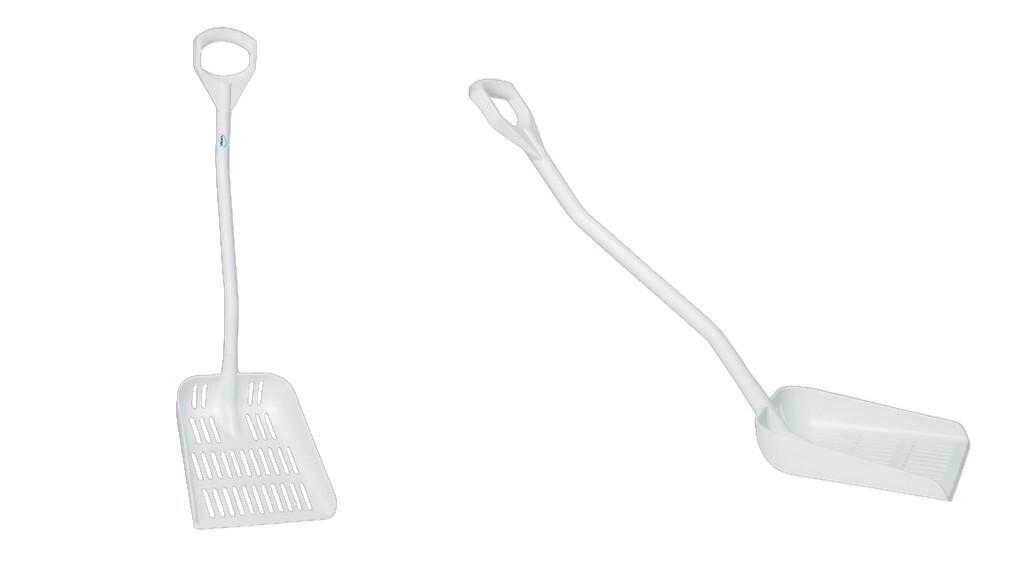
For example, a sanitation zone shovel needs a handle that retains its grip when wet. It also needs a blade pitched to drain efficiently. By contrast, an ingredient-handling shovel in a dry area requires blade geometry suited to loose, dry material. Neither task is well-served by a one-size-fits-all approach.
Bunzl Processor Division carries color-coded food-grade shovels designed for processing environments. The selection spans multiple blade sizes and handle configurations, all of which cover the tasks and zones found across beef, pork, poultry, and prepared foods facilities.
Practical Steps for Facilities Evaluating Their Shovel Program
Assessing your plant’s shovel requirements starts with a task audit. Walk the floor and document where shovels are in use. Then, note what materials the workers move and how long each task takes per shift. Observe whether these workers bend more than the task requires. In addition, check if they make visible grip adjustments during the course of work.
Next, compare your current shovel inventory against the task list. If a generic shovel covers multiple zones and task types, this is an immediate opportunity. By matching the right tools to specific tasks, you can reduce both injury and cross-contamination risks. Multi-plant operations benefit from standardizing an ergonomic, HACCP color-coded shovel program. Doing so supports safety outcomes and audit readiness across locations.
Our food processing expertise helps identify the right shovel specifications for our clients’ individual requirements. This includes providing food shovels with different handle configurations, shaft lengths, blade sizes, and color designations. We work directly with processing facilities to match the right tools to tasks across all plant zones.
Need help finding the right shovel for your facility? Call 800-456-5624 or chat with us online. You can also reach our safety experts directly by submitting our Ask An Expert online web form.