
Hand injuries are among the most common and most preventable accidents in meat and food processing. Selecting the right cut-resistant glove for each task is a direct line from hazard assessment to injury prevention. Choose too low a level and the glove fails when it matters most. Choose too high, and operators lose the dexterity and comfort they need to work safely.
We, at Bunzl Processor Division, pride ourselves on being the leading single-source distributor for food and meat processing facilities. Our full range of cut-resistant gloves, which include the BPD-exclusive WorkHorse® brand, provides multiple ANSI/ISEA 105-2024 protection levels.
How ANSI/ISEA 105-2024 Cut-Resistant Standard Levels Work
The standard rates cut-resistant gloves on a nine-level scale, from A1 to A9. Each level reflects the grams of force required to cut through the glove material using a TDM-100 standard testing machine. The higher the level, the greater the cut resistance, though higher levels also tend to mean less flexibility in the glove.
Glove gauge works alongside ANSI/ISEA level to determine how a glove feels and performs, as the gauge number indicates the number of threads per inch used in construction. A higher gauge means a thinner, more flexible, form-fitting glove, while a lower gauge uses thicker threads for heavier-duty protection. Understanding both numbers together gives you a clearer picture of how a glove will perform on the line.
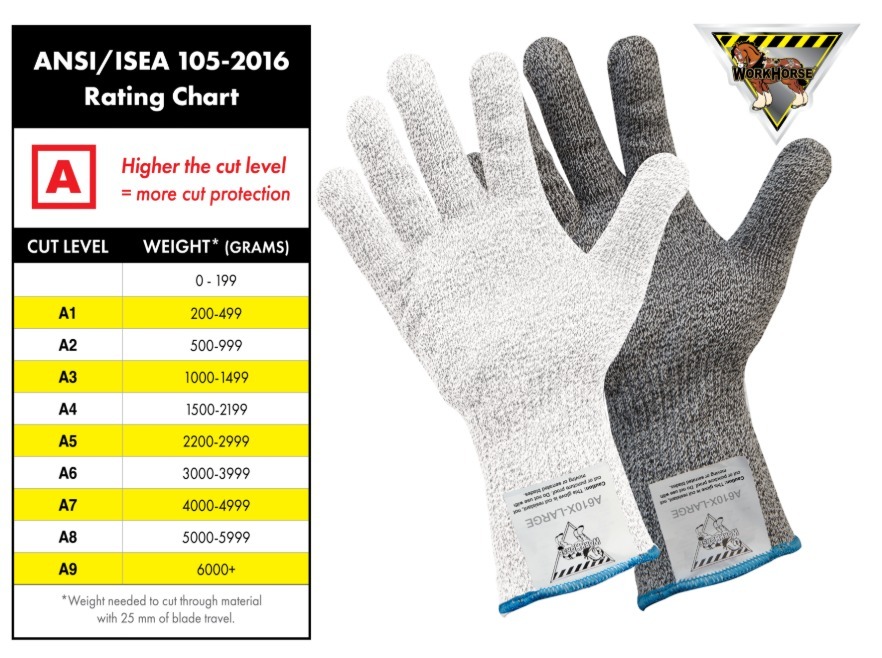
The ANSI/ISEA 105-2024 standard also introduced a new pentagon label. This label shows cut, puncture, and abrasion ratings in one place. As a result, it's easier to compare gloves across brands and pick the right level for the task.
Cut-Resistant Glove Levels for Meat and Food Processing
Meat processing falls into the higher-risk range of the ANSI/ISEA-105. Levels A1 through A3 cover light-duty tasks such as packaging and general material handling. Levels A4 through A6 apply to medium-duty work. For knife work, deboning, and handling sharp tools, levels A7 and above are generally the right choice.
Poultry processing introduces additional considerations, as high-speed line work with shears and curved knives creates cut exposure from multiple angles throughout a shift. Seafood processing similarly involves scaling, filleting, and shell handling, where blade contact is frequent and often unpredictable. In both environments, a minimum of A6 protection is a reasonable baseline, with A7 and above reserved for the highest-exposure tasks on the line.
That said, the right level depends on the specific task. A worker handling packed product may need less protection than one using a boning knife all shift. Glove gauge also plays a role here, since a higher-gauge glove at a given ANSI/ISEA-105 level offers more dexterity for precision knife work (13 gauge and above).
Meanwhile, a lower-gauge option at the same level suits heavier tasks where feel matters less than durability. A thorough hazard assessment is the best starting point for any glove selection. Revisiting that assessment when tasks or tools change keeps your protection levels current.
WorkHorse® Cut-Resistant Gloves from Bunzl
Our WorkHorse cut-resistant gloves are certified across several ANSI/ISEA-105 cut-resistant levels. Our quality standards make it easier for clients to match the right glove to the right task on the line.
For example, our WorkHorse A4 offers ANSI/ISEA-105 Level A4 protection in a light 13-gauge design. It's built for knife-hand use with a seamless, ultra-lightweight construction for all-day comfort. This is a strong choice for lower-risk cutting tasks where dexterity matters most.
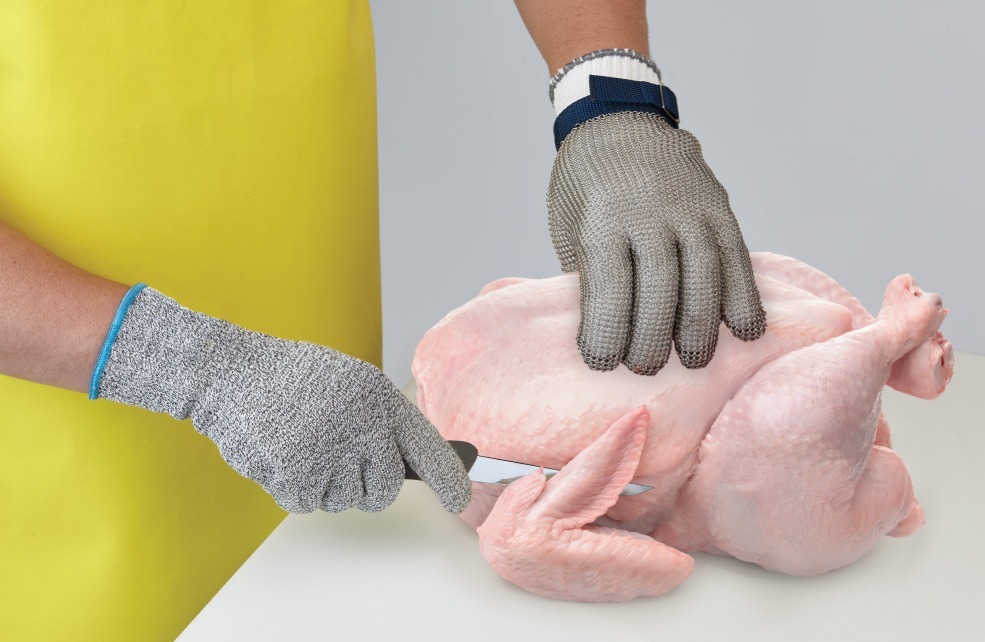
Additionally, our WorkHorse A6 remains our top-selling cut-resistant glove. It offers ANSI/ISEA-105 Level A6 protection in both 10-gauge and 7-gauge versions. The 10-gauge model balances flex, comfort, and cut resistance for most meat processing tasks. The 7-gauge version adds a texture that improves grip. Both are ambidextrous, machine washable, and 100% latex- and silicone-free.
For high-risk applications, the WorkHorse A7, A8, and A9 delivers higher cut-resistance 10- and 13-gauge options. It uses antimicrobial fibers that meet FDA approval and USDA requirements for direct food contact. This makes it one of the few high-protection options built for food handling environments. Like other WorkHorse gloves, it also resists acids, alkali, and organic solvents.
Matching the Level to the Task
Selecting cut-resistant gloves means matching the protection level to the actual hazard. Furthermore, comfort and dexterity matter too. A glove that causes significant hand fatigue because it’s too stiff or too hot to be worn, defeats the purpose.
Also consider wash durability. In meat processing, gloves go through frequent sanitation cycles. WorkHorse gloves are machine washable, which supports both hygiene and long service life. Additionally, extended cuff options are available for tasks where wrist protection is also a factor.
We welcome you to try out our cut-resistant gloves across the full ANSI/ISEA-105 standard range, which includes the WorkHorse offering and other trusted brands. If you want to learn more about glove selection for processing environments, read this informative article on when to wear cut-resistant gloves. Need assistance? Call 800-456-5624 or submit our 'Ask An Expert' online form to reach our safety experts directly.